
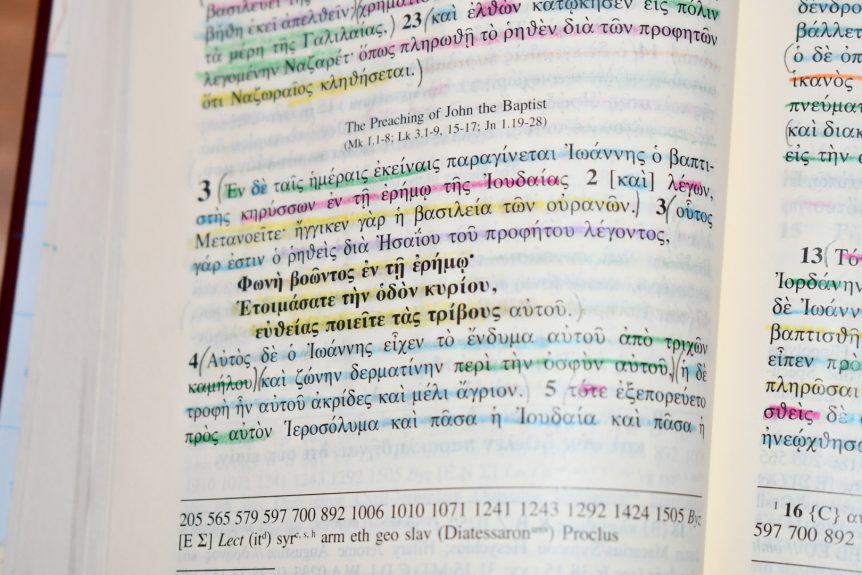
Isaiah 40.3-5:
A voice cries:
“In the wilderness prepare the way of the Lord;
make straight in the desert a highway for our God.
Every valley shall be lifted up, and every mountain and hill be made low;
the uneven ground shall become level, and the rough places a plain.
And the glory of the Lord shall be revealed,
and all flesh shall see it together,
for the mouth of the Lord has spoken.” (ESV)
Matthew 3.3:
For this is he who was spoken of by the prophet Isaiah when he said:
“The voice of one crying in the wilderness:
‘Prepare the way of the Lord;
make his paths straight'”. (ESV)
The time for the public ministry of Jesus had come. But in accordance with the prophecy of Isaiah 40.3-5, and the two references of Malachi 3.1 and 4.5-6, a messenger will go before Jesus to get everyone ready for His appearing. This messenger was John the Baptist. Chapter 1 of the Gospel of Luke gives us the background of John, and from the the prophecy spoken by John’s dad, it was revealed that this ministry of the messenger was appointed for John.
There must be a forerunner appointed for Jesus, because the coming of Jesus is the coming of the King. And so there must be an official messenger to go ahead of Jesus to announce His soon arrival. This will allow the people to get themselves ready. The language of Isaiah above reveals the imagery of getting roads smoothed out, potholes filled in, lowering bumps in the road and making sure the elevation of the road itself is ideal. It was language figuratively used to call the people to get their lives straightened out with God. Cleaned up. Set in order. Prepared for the King. The type of preparation called for by the preaching of John the Baptist was a call to personal repentance and a baptism signifying the repentance that had taken place. It was a call for people to change the way they lived their lives. To live the way God wants all of us to live.
The messenger who would prepare the way for the Messiah was likened to Elijah, and because of the way the last two verses of the Old Testament are written, many people thought that the messenger/forerunner would actually be Elijah himself. Elijah wore a garment of hair and a leather belt around his waist (2 Kings 1.8) and so did John. The symbolic connection of John to Elijah was prominently displayed, and Jesus confirmed to His disciples in Matthew 11.14 that John was the Elijah who was to come.
And in all of this John was the prophet pointing to Jesus, Who would establish the New Covenant by His death on the cross and His resurrection from the dead. In addition to John the Baptist being a reformer and a forerunner, He also preached the gospel. And in a significant way he in effect did the work of an evangelist. Luke 3.18 says of John: “So with many other exhortations also he preached the gospel to the people.”(NAS). And the Gospel of John 1.7 says of John the Baptist that: “He came as a witness to bear witness about the light, that all might believe through him.”(ESV). John the Baptist called people to repent of their sins and believe in Jesus as the Son of God.
We can learn much from John’s approach to communicating. Direct. Courageous. Uncompromising. In some respects not particularly “seeker friendly”. And he zeroed in on repentance and faith in Jesus as: “the Lamb of God, who takes away the sin of the world.” (John 1.29) (ESV).